Note: Certain customer details have been anonymized to respect confidentiality agreements and enterprise security policies while preserving the accuracy and integrity of the outcomes described.
At a Glance
Industry: Sports, Entertainment, and Mixed-Use Real Estate
Region: North America
Scale: 300-acre campus · Major global events · Multi-team operational environment
Challenge: Deliver reliable internal applications across a large-scale campus while maintaining predictability, architectural consistency, and delivery capacity
Solution: Standardized internal application development with FlutterFlow Enterprise
Results:
- Accelerated delivery of production-ready internal applications
- Reduced reliance on individual developers for complex systems
- Improved predictability through defined milestones and structured rollout
- Faster issue identification and resolution during live events
- Scalable internal application development without expanding headcount
Background & Overview
This large-scale sports and entertainment campus spans 300 acres and hosts major global events, including championship games and upcoming international tournaments. The environment includes stadium operations, retail, residential areas, parking infrastructure, media systems, and immersive experiences.
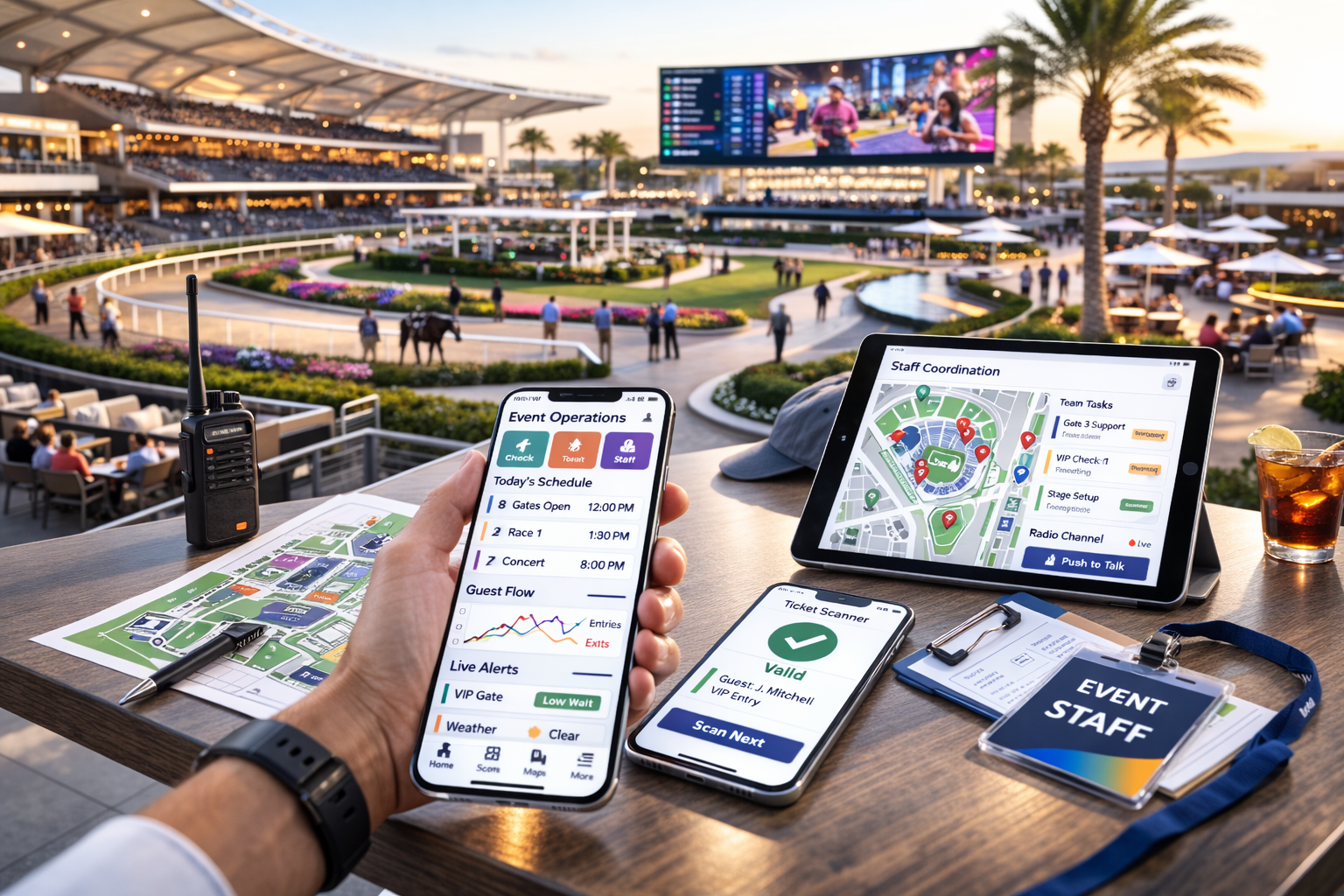
During live events, every operational system is activated simultaneously. Internal applications support facilities, signage, staffing, inventory, mapping, and media control. These tools must function reliably in motion and under time pressure.
The IT Innovation and Integration teams are responsible for delivering and maintaining these systems within structured budget cycles and limited flexibility to expand engineering headcount.
The Challenge
As operational demands expanded, several constraints became clear:
Growing Application Backlog
Internal teams required applications for grounds management, staff deployment, IPTV control, asset tracking, and inventory management across hundreds of campus assets.
Concentrated Engineering Risk
Highly sophisticated applications were often owned by a small number of developers. Priority shifts and stakeholder changes created rework and delivery delays.
Event-Time Reliability Requirements
Applications were frequently used on-site during live events. Performance and mobile responsiveness directly affected operations.
Limited Capacity Expansion
Budget cycles and approval structures limited the ability to rapidly add headcount, increasing the need for predictable and structured delivery.
Success Criteria
IT leadership aligned on measurable objectives:
- Deliver internal applications iteratively with realistic timelines
- Reduce dependency on single developers
- Establish architectural guardrails for less-experienced engineers
- Improve milestone clarity and stakeholder alignment
- Move proof-of-concepts into production-ready, scalable systems
The Solution
To standardize internal application delivery, the large-scale sports and entertainment campus adopted FlutterFlow Enterprise as the structured foundation for its internal experience layer.
The initiative focused on improving release velocity, enforcing architectural consistency, and embedding delivery expertise alongside the internal team.
Accelerated Internal Delivery
Visual development and reusable components enabled rapid assembly of internal tools for mapping, inventory, media control, and asset management. Teams advanced multiple workflows in parallel while maintaining consistent structure across applications.
Enforced Architectural Guardrails
Shared patterns and structured workflows reduced implementation variance between projects. Internal applications were built with consistent logic, deployment processes, and integration standards across Google Cloud, Firebase, authentication, and mapping systems.
Engineering Partnership and Scale
FlutterFlow Enterprise provided ongoing engineering collaboration aligned with how the IT team operated. Dedicated support hours and architectural guidance ensured complex areas such as mapping logic, data modeling, and deployment were addressed without stalling progress. FlutterFlow developers functioned as an extension of the internal team, expanding delivery capacity while the campus retained ownership of priorities and outcomes.
The Rollout
Phase 1: Targeted Internal Applications
Early initiatives included an internal TV Remote application and a Grounds Inventory App tracking more than 320 exterior signage assets. Adoption was immediate, and additional feature requests validated the delivery model.
Phase 2: Milestone Alignment and Predictability
Clear version milestones, including defined v1 commitments, improved stakeholder alignment and reduced rework. Delivery timelines became more predictable across initiatives.
Phase 3: Standardized Application Foundation
Reusable components and structured patterns enabled expansion across additional internal workflows without rebuilding from scratch. The initial applications became templates for subsequent projects.
The Outcomes
Accelerated Production Deployment
Internal applications moved from proof-of-concept to live production environments with greater speed and stability.
Reduced Concentration Risk
Delivery responsibilities were distributed more evenly across the team, reducing dependency on individual developers.
Improved Operational Responsiveness
Issues related to signage, facilities, and inventory were identified and routed faster during live events.
Scalable Delivery Without Headcount Expansion
The organization advanced multiple initiatives in parallel without proportionally increasing engineering staff.
What It Means for Enterprise IT Leaders
In high-visibility environments, internal applications function as operational infrastructure. Predictability, architectural consistency, and delivery capacity directly affect event execution.
By standardizing internal application development with FlutterFlow Enterprise, the large-scale sports and entertainment campus established a structured delivery model capable of supporting large-scale events, evolving operational requirements, and multi-team coordination.
The result is a scalable internal application capability aligned with both innovation speed and operational reliability.
Looking for a partner, not just a platform?
Book a consultation to explore how FlutterFlow Enterprise can support your internal application strategy.